

Introduction
Running one childcare centre is operationally demanding. Running five, ten, or twenty requires a different order of thinking entirely.
Multi-site providers are the fastest-growing segment of Australia's early childhood education and care sector. Corporate and not-for-profit groups now operate large networks of services across metropolitan regions, regional towns, and interstate locations. The operational advantages of scale are real: shared services, procurement power, consistent curriculum, and the ability to move resources between locations.
But scale also amplifies the hardest operational challenge in the sector: workforce management. And nowhere is that amplification more acute than in permanent recruitment.
At a single centre, a permanent hiring gap is painful. You know the team, you know the gap, and you manage the response locally. At a multi-site provider with ten or twenty services, permanent recruitment gaps stack. A Room Leader vacancy in one location, a Director search in another, three Diploma-qualified educators to hire before ratios are met at a third. Each gap has its own timeline, its own urgency, and its own compliance implications. Managing all of them coherently, across different geographies and different teams, without a centralised system is one of the defining operational challenges of multi-site childcare in 2026.
This guide is for the operators, area managers, HR leads, and operations teams responsible for permanent recruitment across multiple childcare centres. It covers the specific challenges that multi-site recruitment creates, where traditional approaches fail at scale, and what a modern workforce platform approach looks like in practice.
The multi-site recruitment problem is a systems problem
The first thing to understand about permanent recruitment across multiple childcare sites is that the problem is not primarily a sourcing problem. It is a systems problem.
A single centre recruits episodically. A vacancy opens, the director posts a job ad, screens candidates, conducts interviews, and makes a hire. It is labour-intensive, but it is manageable because it happens intermittently and is handled by one person who knows the role, the team, and the culture intimately.
A multi-site provider recruits continuously. At any given point across a network of ten services, there will almost always be at least one active permanent vacancy, and often several. According to the Productivity Commission, nearly 77 per cent of Australian childcare educators report being chronically understaffed. With the sector facing a shortage of approximately 21,000 qualified ECEC professionals and annual turnover rates that consistently drain experienced staff from teams, a multi-site provider cannot afford to treat each vacancy as an isolated episode. Recruitment has to be a continuous, coordinated function.
The practical challenge is that most multi-site providers do not have systems built for continuous, coordinated recruitment. They have site-level directors doing their best with job boards, referral networks, and agencies. This creates three predictable failure modes.
The first is duplication. Multiple sites running separate recruitment processes for similar roles, paying separate agency fees, competing with each other for the same small pool of qualified candidates.
The second is inconsistency. Without centralised credential verification, qualification assessment, and onboarding processes, standards vary between sites. The Diploma-qualified educator hired at one service may meet different criteria than the one hired at another, with different implications for ratio compliance, NQS quality ratings, and regulatory risk.
The third is invisibility. Leadership cannot see the aggregate workforce picture across the network: how many permanent vacancies are currently open, how long each has been unfilled, what the compliance status of the current workforce is across all sites. Decisions are made locally, reactively, without the full picture.
Compliance is a network-level risk, not a site-level risk
For single-site operators, compliance management is a contained problem. For multi-site providers, it is a network-level risk that scales with every site added to the portfolio.
The compliance obligations under the National Quality Framework are the same at every site: current Working With Children Checks, valid First Aid qualifications, annual CPR and anaphylaxis management training, and the correct ratio of qualified educators at all times. But when those obligations have to be monitored across ten or twenty sites, with hundreds of educator credential records in play, the administrative challenge becomes exponentially more complex.
Amendments to the National Law from 27 February 2026 introduced the most significant regulatory overhaul to Australian childcare since the NQF began. Maximum penalties are set to triple. A new national early childhood worker register is being built. Unannounced site visits have been underway since November 2025. The regulatory environment is not easing. It is intensifying.
For a multi-site provider managing compliance manually, across spreadsheets maintained by individual site directors, the risk of a credential expiry being missed, a qualification gap going undetected, or a ratio breach occurring without warning is not hypothetical. It is a function of volume and the limitations of manual systems.
A single compliance incident at one site affects the whole network. It affects the provider's approval status, its quality ratings, its reputation with families, and its relationship with the regulator. Multi-site providers cannot manage compliance as ten or twenty individual site problems. They need network-level visibility.
Why agency-based permanent recruitment fails at scale
Many multi-site providers default to agencies for permanent placements, particularly at the room leader and director levels. Agencies provide a shortlisting service, reduce the director's administrative burden, and offer replacement guarantees if an early departure occurs. For a single urgent hire, the proposition is reasonable.
For a multi-site provider filling permanent roles continuously across a network, the economics fall apart quickly.
Childcare agencies charge 15 to 20 per cent of the annual salary for permanent placements. General recruitment agencies in Australia charge 18 to 25 per cent for mid-level roles. A Room Leader hire at $75,000 carries a fee of $11,250 to $15,000. A Centre Director hire at $95,000 carries a fee of $17,100 to $23,750.
For a network of ten sites each replacing two to three permanent staff per year, the annual placement fee bill can run to $200,000 to $400,000 or more, depending on the roles and the fee rates negotiated. This is not an edge case. It is a routine cost for multi-site providers that have not built an alternative recruitment infrastructure.
Beyond the fee cost, agency-sourced hires arrive with compliance records held by the agency, not the provider. The provider gains an employee but not ownership of the verification trail. At a multi-site level, this creates a compliance documentation gap that auditors and regulators will notice.
What a platform approach to multi-site recruitment looks like
The most effective multi-site providers in 2026 are moving away from episodic, agency-dependent recruitment toward a continuous, platform-based model. The difference is structural.
A platform approach means permanent recruitment is managed from a single system that spans the entire network. Vacancies are visible centrally. Candidate pipelines are shared across sites. Credential verification is centralised and standardised. Onboarding processes are consistent. And the compliance status of the workforce across every site is visible in real time to the people responsible for the network.
In practical terms, this changes how permanent recruitment works in three important ways.
A shared casual pool becomes a permanent talent pipeline. In a platform-based model, the casual educators working across the network are already credentialled, already familiar with the provider's culture and practices, and already known to the teams they work with. When a permanent vacancy opens, the first question is not "which agency should we call?" but "who in our casual pool is ready for a permanent role?" Converting a high-performing casual into a permanent hire does not carry a placement fee. It saves $11,000 to $23,000 per conversion, while improving the quality and cultural fit of the hire.
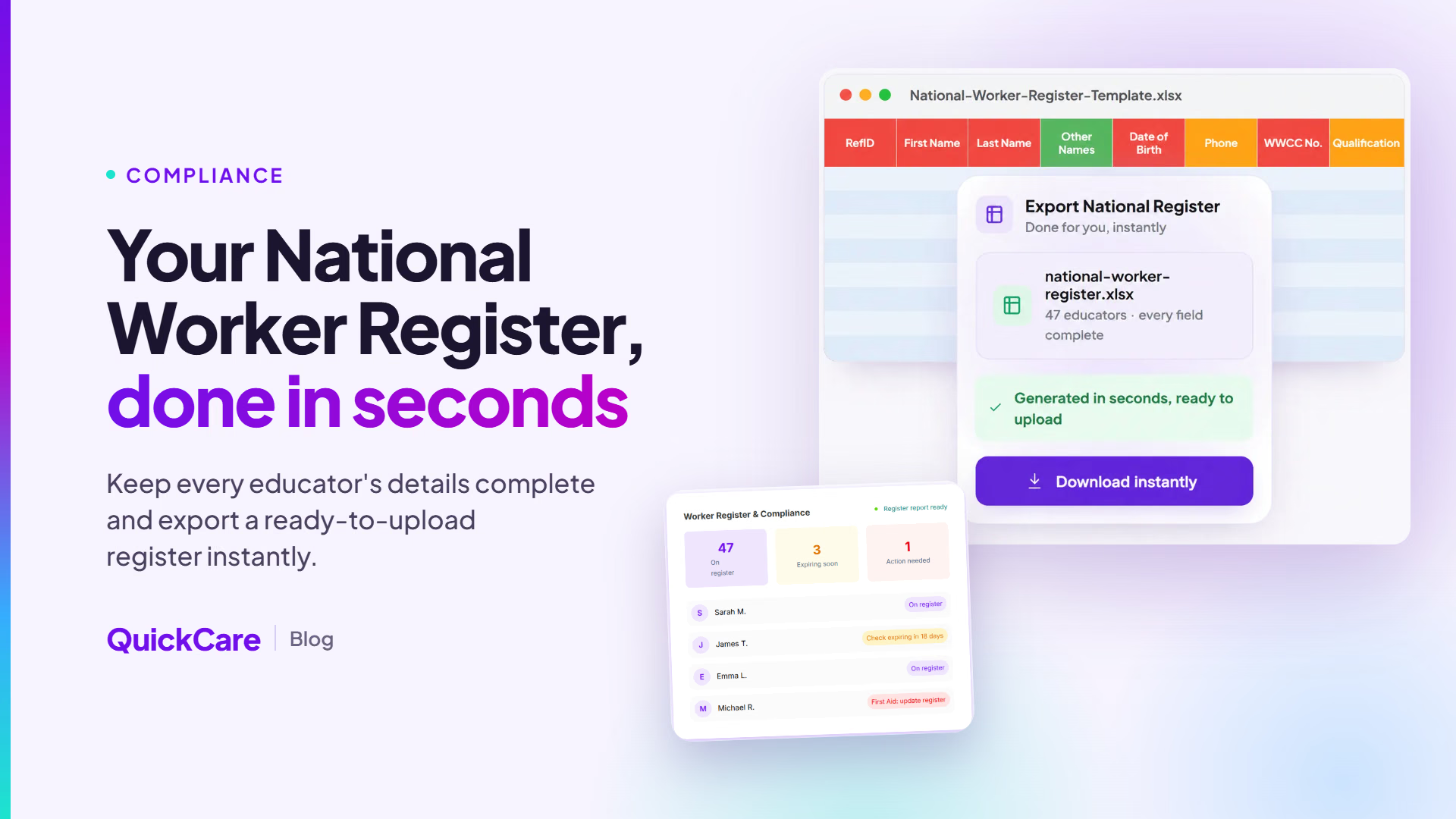
Credential data is owned by the provider, not the agency. When educator credential records are held in a centralised platform rather than by individual agencies or site-level spreadsheets, the provider has a single source of truth for its entire workforce. WWCC status, First Aid currency, qualification levels, and mandatory training records are visible in one place, across all sites, in real time. Gaps are flagged automatically. Compliance reporting becomes a dashboard exercise rather than a manual audit.
Workforce planning becomes proactive rather than reactive. When leadership can see the real-time staffing picture across all sites, predictable vacancies can be identified and addressed before they become urgent. A Room Leader approaching the end of a contract, a Director indicating they may not renew, an area with historically high turnover approaching peak period: with network-level visibility, these are planning inputs rather than surprises.
Practical steps for multi-site providers
If your current permanent recruitment model is primarily site-directed and agency-dependent, the transition to a more centralised, platform-based approach does not need to happen overnight. The practical steps are sequential.
Step one: Centralise your compliance picture. Before you can recruit strategically, you need to know where you stand. Map the current workforce compliance status across all sites: how many educator credential records are you tracking, which are approaching expiry, and how confident are you in the accuracy of that data? Most multi-site providers find gaps in this exercise. Knowing where they are is the starting point.
Step two: Build a network-wide casual pool. A managed pool of vetted, credentialled casual educators who work across multiple sites in your network is both a staffing resource and a permanent hiring pipeline. Educators who work regularly across your sites know your culture, your teams, and your practices. They are your best permanent candidates.
Step three: Create a consistent onboarding process. Permanent hires at every site should go through the same credential verification, qualification confirmation, and onboarding process. Inconsistency in this process creates compliance risk at the sites where it is weakest.
Step four: Track vacancy tenure centrally. A vacancy that has been open for six weeks at one site is a problem. A pattern of vacancies consistently running for six weeks or more across multiple sites is a systems problem. Central visibility of vacancy tenure is the first step toward addressing root causes.
Step five: Measure placement costs and sources. How much is your network spending on permanent placement fees annually, broken down by site and by role level? For most multi-site providers, this analysis reveals a number significantly larger than expected, and a strong financial case for investing in a direct recruitment infrastructure.
How QuickCare supports multi-site permanent recruitment
QuickCare is built for the operational reality of multi-site childcare providers. The platform provides network-wide visibility of workforce compliance, a vetted casual pool that spans all sites, and a permanent hiring pathway that does not involve agency fees.
Every educator in the QuickCare system has verified credentials: WWCC, First Aid, CPR, anaphylaxis management, and qualification level. Those records are owned by the provider, visible in real time across the network, and automatically flagged when expiry approaches. When a credential lapses, the system knows before you do.
For permanent recruitment, QuickCare's casual pool provides the pre-vetted pipeline that replaces the agency shortlisting function. Area managers and HR teams can identify high-performing casuals across the network, assess their suitability for permanent roles, and make offers without paying a placement fee. For multi-site providers currently spending $150,000 to $400,000 annually on placement fees, the saving is transformative.
Workforce visibility across all sites is consolidated in a single dashboard. Open vacancies, current compliance status, ratio coverage, and credential expiry alerts are visible at the network level, not just the site level.
If your organisation is managing permanent recruitment, compliance, and workforce planning across multiple sites and finding that the current model is not scaling, book a demo at quickcarehr.com to see how QuickCare works for networks like yours.