


In 2026, the Australian early childhood education (ECE) sector is no longer just "regulated," it is under a digital microscope. With the recent tripling of maximum penalties under the National Law and the rollout of the national educator registration scheme, the margin for error has vanished.
For multi-site operators, a single compliance "corner cut" in one centre can trigger a systemic audit across the entire group. Below is a breakdown of the five most critical compliance failures currently impacting the bottom line and how to insulate your business.
1. The "Ghost" WWCC: Invalid Verification
As of February 2026, the Australian Government Department of Education has mandated that all staff must have a valid Working With Children Check (WWCC) verified before they commence work.
The Failure: Relying on a physical card or a "lookup" performed six months ago. WWCC statuses can change overnight.The Impact: Fines for an individual can now exceed $34,000, while providers face penalties of up to $172,000 for allowing unvetted staff on-site. Beyond the fine, the reputational damage of a "Safety Alert" on your NQS rating is often permanent.
2. Inadequate Supervision (Section 165 Breaches)
Supervision remains the most common reason for emergency action notices in 2026.
The Failure: Cutting corners on ratios during "shoulder periods" (early morning/late afternoon) or relying on unverified casuals who haven't been properly inducted into the centre’s specific layout.The Impact: Recent State Administrative Tribunal rulings have seen penalties totaling $32,000 for single incidents where supervision was deemed inadequate.
3. The "Manual Trap": Regulatory Record Storage
Under Regulation 183, improper record and document storage is now a strictly enforced offence.
The Failure: Keeping educator qualifications, First Aid, and CPR certificates in manual folders or fragmented email chains. If an authorized officer requests a Quality Improvement Plan (QIP) or a staff record and it isn't produced instantly, it’s an automatic infringement.The Impact: New "Penalty Infringement Notices" (PINs) act like speeding tickets for childcare, instant monetary fines equal to 10% of the maximum penalty.
4. Failure to Report Misconduct (Reportable Conduct Scheme)
With the Reportable Conduct Scheme coming into full effect for all sectors by July 2026, the "head of the organisation" is now personally liable for reporting failures.
The Failure: Internalising "low-level" educator misconduct without notifying the Regulatory Authority within the mandatory 24–48 hour window.The Impact: Financial penalties of $16,690 per instance and a mandatory recording of the failure on a public register, which can disqualify providers from receiving Child Care Subsidy (CCS) payments.
5. The "Agency Markup" Drain: Financial Non-Compliance
While not a regulatory fine, relying on traditional agencies to "fix" compliance is a failure of fiscal duty.
The Failure: Paying 40% markups to agencies that provide "vetted" staff who arrive with expired documents.The Impact: For a multi-site group, this "compliance tax" can leak upwards of $300k per month. You are essentially paying a premium for a risk you still own.
How to Insulate Your Business for 2026
The solution isn't more admin hours; it’s better architecture. By moving to a BYO Workforce model, centres can bypass the middleman and the risks they bring.
The Compliance Passport
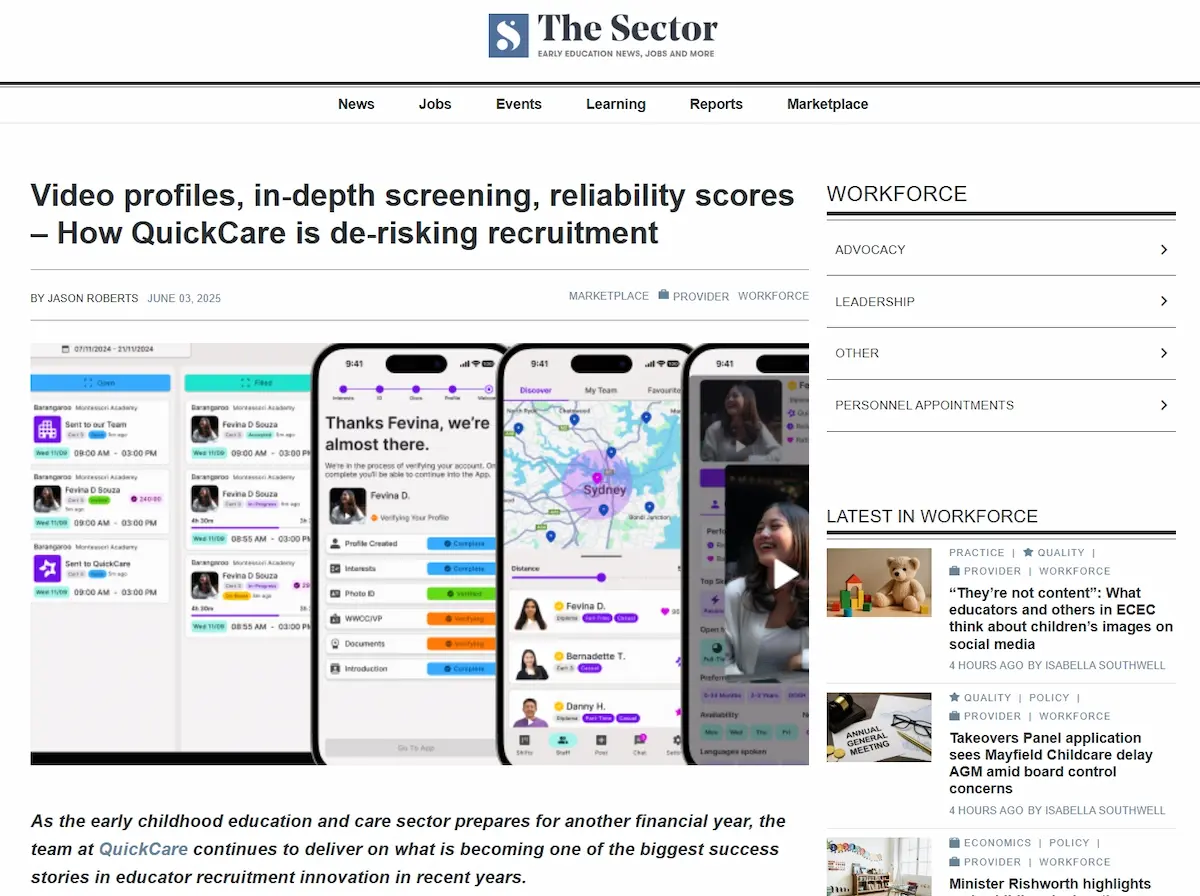
Every educator on the QuickCare platform carries a digital "Compliance Passport." Our system uses direct integrations with training.gov.au and state WWCC portals to verify credentials daily. If a certificate expires, that educator is automatically "locked" from picking up shifts until it’s updated.
The $10,000 Guarantee
We don't just talk about safety; we insure it. QuickCare provides a $10,000 Compliance Guarantee. If a Regulatory Authority issues a fine due to a documentation failure on our end, we cover the cost. This shifts the risk from your balance sheet to our technology.
Conclusion: Profitability Requires Protection
In the 2026 ECE market, the most profitable centres aren't those that "cut corners" on staffing, they are the ones that have automated their compliance to focus on quality of care.
Don't wait for an audit to realize your manual systems are failing. Transition your casual pool to a verified, transparent, and cost-effective ecosystem.
Book a Demo with the QuickCare Team | Calculate Your Potential Savings


.jpg)

%20(1).jpg)
.jpg)
.jpg)







.webp)